Real Estate Tax Strategy
What Is a Cost Segregation Study — And Why Most Property Owners Haven’t Done One Yet
A plain-English guide to one of the most powerful — and most overlooked — tax strategies in real estate.
If you own commercial real estate or a rental property, there’s a good chance you’re leaving thousands of dollars on the table every year. A cost segregation study could change that — yet most property owners have never heard of it, let alone used it. Here’s what it is, how it works, and why it might be time to find out if it applies to you.
What Is a Cost Segregation Study?
A cost segregation study is a detailed tax analysis that breaks your property down into individual pieces — and finds which pieces can be written off faster on your taxes.
Here’s the simple version: When you buy a building, the IRS says you can depreciate (write off) the entire thing over 27.5 years for residential rental property or 39 years for commercial property. That’s a very long time to wait for your tax deductions. (You can read the IRS’s official rules on depreciation at IRS.gov.)
But here’s the thing — not everything in a building lasts 39 years. Your parking lot wears out faster than your foundation. Your flooring needs replacing sooner than your roof beams. Your decorative lighting has a shorter life than the building’s concrete walls.
A cost segregation study identifies those shorter-lived components and puts them in faster depreciation categories: 5 years, 7 years, or 15 years instead of 27.5 or 39 years. That means bigger tax deductions now, rather than waiting decades to receive them.
A cost segregation study is an engineering-based analysis of a property’s construction or acquisition costs. It identifies which assets qualify for accelerated depreciation under the Modified Accelerated Cost Recovery System (MACRS) — the IRS’s system for calculating depreciation on business property.
Why It Matters: The Simple Math
Let’s say you buy a commercial building for $1,000,000.
Without a cost segregation study: Your annual depreciation deduction is roughly $25,641 per year, spread over 39 years.
With a cost segregation study: Typically, 20% to 40% of a building’s components can be reclassified into shorter-lived categories. That means $200,000–$400,000 of the building’s value could be depreciated over 5, 7, or 15 years — or potentially written off entirely in the first year thanks to bonus depreciation.
Assume 30% of the building ($300,000) is reclassified to shorter-lived categories and fully expensed in Year 1 via bonus depreciation. At a 30% effective tax rate, that’s a $90,000 tax reduction in Year 1 alone — compared to roughly $7,692 you’d get under standard 39-year depreciation that same year.
The cost of the study? Typically $3,000–$12,000 depending on property size. The return is hard to ignore.
What Gets Reclassified?
Here’s a plain-English breakdown of what commonly qualifies for shorter depreciation lives, according to KBKG, a leading cost segregation firm:
5–7 Year Property (Personal Property)
- Appliances and kitchen equipment
- Specialized electrical systems dedicated to equipment (not general lighting)
- Removable flooring and carpeting
- Decorative lighting and signage
- Furniture and built-in cabinetry
- Security and alarm systems
15-Year Property (Land Improvements)
- Parking lots and paved driveways
- Exterior landscaping and irrigation systems
- Sidewalks and walkways
- Fencing and retaining walls
- Outdoor lighting fixtures
These items are physically part of your building — but from a tax perspective, they don’t need to be bundled with the building’s 39-year recovery period. A quality study documents each one individually with full IRS-compliant support. The IRS’s own Cost Segregation Audit Techniques Guide outlines the 13 elements every quality study must contain.
Who Qualifies?
Cost segregation studies are not just for large corporations or skyscrapers. They can work for a wide range of property types and owners, including:
- Commercial buildings (office, retail, warehouse, restaurant)
- Residential rental properties (apartments, multi-family, short-term rentals)
- Medical, dental, and professional office buildings
- Hotels and hospitality properties
- Self-storage facilities
- Industrial and manufacturing buildings
- Any non-residential real property placed in service after December 31, 1986
As a general rule, studies tend to make financial sense for properties with a depreciable cost basis of $500,000 or more. The study’s cost needs to be outweighed by the tax savings it unlocks. For leasehold improvement projects, the threshold can drop to around $200,000–$300,000.
If you’ve owned a property for years and never done a cost segregation study, you may not have lost out entirely. The IRS allows what’s called a “look-back study” — which lets you catch up on missed accelerated depreciation from prior years, all in one lump sum on your current-year return, without amending prior returns. Learn more about this at 1031 Exchange Corporation.
Bonus Depreciation in 2025 and Beyond
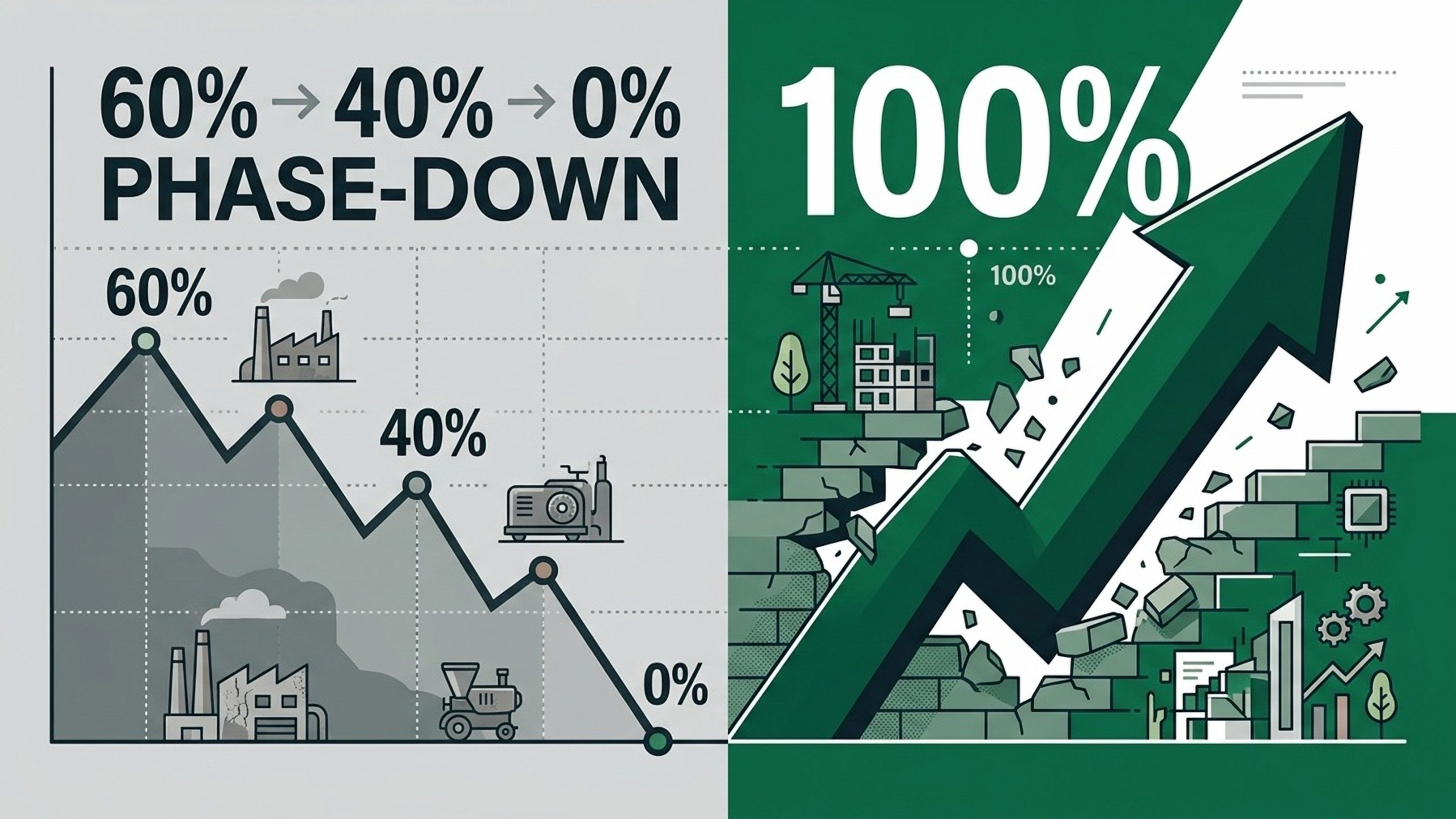
The tax landscape for cost segregation got significantly better in 2025. On July 4, 2025, the One Big Beautiful Bill Act (OBBBA) permanently restored 100% bonus depreciation for qualifying property acquired and placed in service after January 19, 2025. This reverses the phasedown schedule that had reduced bonus depreciation to 40% for 2025 and was heading toward zero by 2027.
What does this mean in practice? Any building component reclassified into a 5-, 7-, or 15-year category through a cost segregation study can now be fully expensed in Year 1. That’s not a deduction spread over five years — that’s a single, large deduction in your first tax year of ownership. According to Grant Thornton, this applies to most tangible property with a recovery period of 20 years or less, including used property.
The 100% bonus depreciation rate applies to qualifying property acquired after January 19, 2025. Property placed in service between January 1 and January 19, 2025, is limited to 40% bonus depreciation. If you’re planning a purchase, acquisition date matters — EisnerAmper explains the TCJA vs. OBBBA rules in detail.
5 Reasons Most Property Owners Haven’t Done One Yet
So why is a strategy this powerful still largely unknown? Here are the most common reasons — and why they may not hold up as well as you think.
❌ “I’ve Never Heard of It”
This is probably the most common reason of all. Cost segregation doesn’t get talked about at the kitchen table. Most property owners work with a general CPA whose focus is filing accurate returns — not proactively hunting down tax strategies. Unless your advisor specializes in real estate taxation, this topic may never come up.
❌ “It Sounds Too Complicated”
Terms like “MACRS asset classes,” “Section 1245 property,” and “engineering-based analysis” can make any property owner’s eyes glaze over. It sounds like something only a Fortune 500 company’s tax team could navigate.
❌ “It’s Only for Big Companies”
A common assumption is that cost segregation is reserved for large real estate portfolios or institutional investors. This may have been partially true decades ago, when the studies were cost-prohibitive for smaller owners.
❌ “I’m Worried It’ll Trigger an IRS Audit”
Fear of the IRS is one of the most powerful forces keeping property owners from pursuing legitimate tax strategies. If something sounds too good, it must be a red flag — right?
❌ “I’ll Just Do It Later”
Procrastination is probably the most expensive mistake on this list. There’s always a reason to put it off — this year is busy, next year will be better, maybe when the loan is refinanced.
How the Process Works (In Plain English)
If you decide to move forward, here’s what you can expect from start to finish:
- Free Feasibility Analysis — Most reputable firms start with a no-cost estimate of your potential tax savings before you commit to anything. This helps you decide whether the study makes financial sense.
- Gather Property Records — You’ll share documents like the purchase agreement, blueprints or construction drawings, renovation invoices, and property tax records.
- Engineering Inspection — A qualified engineer inspects the property — in person or virtually — and documents every component. This is what gives the study its legal defensibility.
- Asset Classification Report — The engineering team classifies each component into the correct depreciation category, with full documentation referencing tax law. The IRS requires 13 specific elements in every quality study, outlined in its Audit Techniques Guide.
- Hand Off to Your CPA — The completed study goes to your tax preparer, who applies the new depreciation schedule to your return. Your CPA doesn’t have to build the study — they just use it.
How Much Does It Cost — And Is It Worth It?
Study fees vary based on the size and complexity of the property. Here’s a general ballpark to help you understand what to expect:
| Property Value | Estimated Study Cost | Potential Year-1 Tax Savings* |
|---|---|---|
| $500K – $1M | $3,000 – $7,500 | $30,000 – $90,000 |
| $1M – $5M | $7,500 – $20,000 | $90,000 – $450,000 |
| $5M – $10M | $20,000 – $35,000 | $450,000 – $900,000 |
| $10M+ | $35,000 – $60,000+ | $900,000+ |
*Estimated savings assume 30% of depreciable basis reclassified and 100% bonus depreciation at a 30% effective tax rate. Individual results vary. Consult a qualified tax professional.
Most cost segregation studies deliver a return of 10x to 30x or more on their cost in first-year tax savings when paired with 100% bonus depreciation. The simple test: if the estimated tax savings exceed the cost of the study by at least 3 to 4 times, it’s almost certainly worth pursuing.
For a deeper breakdown of study fees and ROI considerations, Patrick Accounting’s guide is a useful resource, as is The Real Estate CPA’s overview of how accelerated depreciation works in practice.
The Bottom Line
A cost segregation study doesn’t create new deductions — it accelerates deductions you were already entitled to. It’s the difference between small, steady write-offs spread over 39 years and a large, meaningful deduction in the first year or two of ownership.
Most property owners haven’t done one simply because no one told them to. The good news is that it’s never too late to ask the question — whether you bought a property this year or five years ago.
If you own commercial real estate, a rental property, or a business building with a value of $500,000 or more, this is a conversation worth having with a qualified tax professional who understands real estate depreciation strategy. The savings can be significant. The process is straightforward. And the timing — with 100% bonus depreciation now permanently in place — has rarely been better.
Here are a few trusted resources to explore further: