Tax Law Update · OBBBA 2025
Bonus Depreciation Is Back at 100%: What That Means for Your Next Cost Segregation Study
The most powerful first-year tax deduction in real estate just became permanent. Here’s exactly what changed, who benefits, and how to take full advantage.
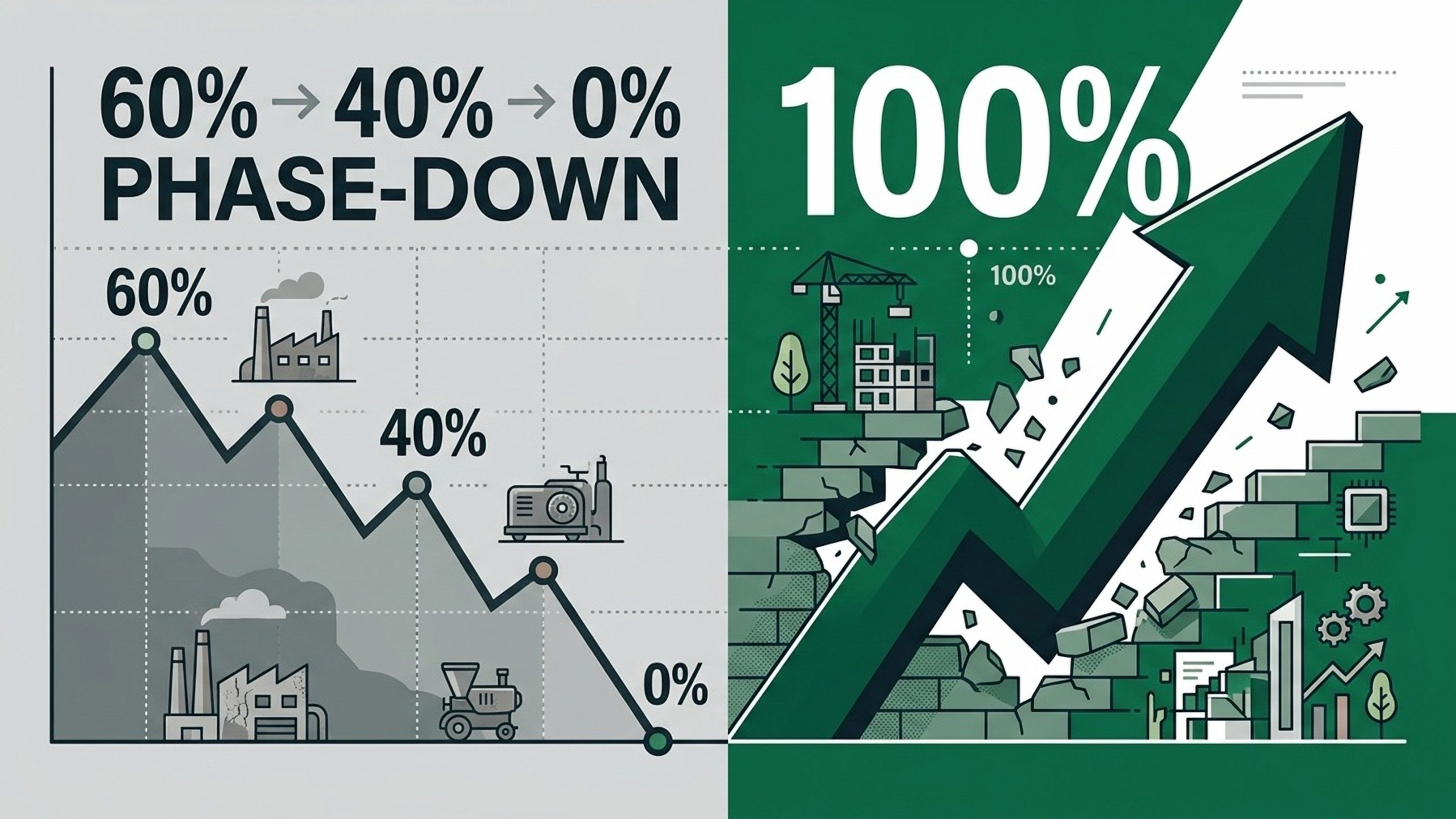
For several years, property owners and real estate investors watched one of their most powerful tax tools slowly disappear. Bonus depreciation — the ability to write off qualifying assets in the first year of ownership instead of over decades — had been phasing out at 20% per year since 2023. It was scheduled to hit zero in 2027.
Then on July 4, 2025, Congress changed course. The One Big Beautiful Bill Act (OBBBA) was signed into law, permanently restoring 100% bonus depreciation and fundamentally reshaping the value of cost segregation studies for every property owner in the country.
What Just Happened: The OBBBA Explained
The One Big Beautiful Bill Act (Public Law 119-21), signed on July 4, 2025, made sweeping changes to the tax code. Among the most significant: it permanently restored 100% first-year bonus depreciation under IRC Section 168(k) for qualifying property acquired and placed in service after January 19, 2025.
Before the OBBBA, bonus depreciation had been phasing out under the Tax Cuts and Jobs Act schedule — 80% in 2023, 60% in 2024, and 40% for 2025, before dropping further toward zero. The OBBBA eliminated that phase-down entirely. For the first time in history, 100% bonus depreciation is now a permanent feature of the federal tax code — not a temporary incentive with an expiration date.
Prior to the OBBBA, even when bonus depreciation was at 100% (2018–2022), it was set to expire. That uncertainty made long-term tax planning difficult. The OBBBA removes that uncertainty entirely. 100% bonus depreciation is now part of the permanent tax code — no expiration, no phase-out scheduled, no need to rush a deal before a sunset date.
How We Got Here: A Brief History of Bonus Depreciation
To understand why the OBBBA is such a big deal, it helps to see how bonus depreciation has changed over time:
-
Pre-
201850% Bonus Depreciation (2017 and earlier)
Bonus depreciation existed but was capped at 50% and applied only to new property. Property owners could write off half the cost of qualifying assets in Year 1. -
2018–
2022100% Bonus Depreciation (TCJA)
The Tax Cuts and Jobs Act of 2017 expanded bonus depreciation to 100% and extended it to used property. For five years, property owners could fully expense qualifying personal property in Year 1 — a massive boon for cost segregation studies. -
2023–
2024Phase-Down Begins (80% → 60%)
The TCJA’s bonus depreciation began phasing out at 20% per year. Studies still generated value, but the immediate impact on Year 1 taxes was diminishing each year. -
Early
202540% Bonus — and Heading Lower
Before the OBBBA, property acquired between January 1 and January 19, 2025, was limited to 40% bonus depreciation. By 2027, it would have hit zero under existing law. -
July 4
2025OBBBA Signed — 100% Bonus Depreciation Restored Permanently
For qualifying property acquired and placed in service after January 19, 2025, 100% bonus depreciation is fully restored and made permanent. The phase-down schedule is eliminated entirely. -
2026
+100% Bonus Is the New Normal
Property owners can now plan capital expenditures and real estate acquisitions with the confidence that full first-year expensing of qualifying assets is here to stay — no sunset, no phase-out on the horizon.
How Bonus Depreciation and Cost Segregation Work Together
It’s important to understand what bonus depreciation does not do on its own: it does not apply to the building itself. A standard commercial property is still depreciated over 39 years. A residential rental is still depreciated over 27.5 years. Bonus depreciation cannot change those timelines for the structural building.
What bonus depreciation does apply to is property with a recovery period of 20 years or less — meaning personal property (5- and 7-year assets) and land improvements (15-year assets). And that is exactly where cost segregation comes in.
A cost segregation study identifies the specific components of your building that qualify for those shorter tax lives — flooring, specialized electrical systems, parking lots, landscaping, fixtures, and more. Once those components are reclassified through a study, bonus depreciation applies to the full reclassified amount. With the rate back at 100%, those reclassified assets can be fully expensed in the very first year.
You purchase a $3 million commercial building. A cost segregation study identifies $600,000 worth of components that qualify for 5-, 7-, and 15-year lives. Without bonus depreciation, those assets would be depreciated over their respective shorter schedules — better than 39 years, but still spread out. With 100% bonus depreciation, the entire $600,000 is deducted in Year 1. At a 35% effective tax rate, that’s $210,000 of tax savings in your first year of ownership — as described by experts at Kahn, Litwin, Renza & Co.
Before vs. After: The Numbers Side by Side
To see the full impact, let’s compare the same $1 million commercial building under the old phase-down rules versus the restored 100% rate. Assume 30% of the property ($300,000) is reclassified through a cost segregation study, and the owner is in a 32% federal tax bracket.
60% Bonus Depreciation
- Reclassified assets: $300,000
- Bonus depreciation (60%): $180,000
- Remaining depreciated over 5–15 yrs: $120,000
- Year 1 tax deduction (bonus portion): $180,000
100% Bonus Depreciation
- Reclassified assets: $300,000
- Bonus depreciation (100%): $300,000
- Remaining on standard schedule: $0
- Year 1 tax deduction (full amount): $300,000
That’s a $38,400 difference in Year 1 savings from the same property, the same study, and the same tax bracket — just from the change in the bonus depreciation rate. The higher the value of reclassified assets and the higher your tax bracket, the more dramatic that difference becomes.
Here’s how the Year 1 tax savings scale with property value under 100% bonus depreciation, assuming 30% reclassification and a 32% tax rate:
| Property Value | Est. Reclassified (30%) | Year 1 Tax Savings (32%) | Estimated Study Cost |
|---|---|---|---|
| $500,000 | $150,000 | $48,000 | $3,000 – $7,500 |
| $1,000,000 | $300,000 | $96,000 | $7,500 – $12,000 |
| $2,500,000 | $750,000 | $240,000 | $12,000 – $20,000 |
| $5,000,000 | $1,500,000 | $480,000 | $20,000 – $35,000 |
| $10,000,000 | $3,000,000 | $960,000 | $35,000 – $60,000+ |
*Estimates assume 30% reclassification rate and 32% effective federal tax rate. Actual results vary by property type, condition, and individual tax situation. Consult a qualified tax professional.
Who Qualifies — and the Critical Timing Rules
Not all property automatically qualifies for 100% bonus depreciation under the OBBBA. The rules contain important timing conditions that every property owner needs to understand. Getting the dates wrong could mean the difference between 100% and 40% expensing.
The Two-Part Test
Under the OBBBA, a property must satisfy both of the following conditions to qualify for 100% bonus depreciation:
- Acquired after January 19, 2025 — The date of acquisition (or the date of a written binding contract) must be January 20, 2025, or later
- Placed in service after January 19, 2025 — The property must be placed into active use after the same date
Property placed in service between January 1 and January 19, 2025, is still subject to the 40% bonus depreciation rate under the prior TCJA rules — even if this technically falls in the same tax year as OBBBA. Additionally, if a written binding contract was signed before January 20, 2025, the property may not qualify for 100% bonus even if it was placed in service later in 2025. Acquisition date and contract date both matter. For a detailed breakdown of the TCJA vs. OBBBA timing rules, EisnerAmper’s analysis is highly recommended reading.
What Property Qualifies?
The following categories are eligible for 100% bonus depreciation under the OBBBA, as confirmed by PwC’s analysis:
- Tangible personal property with a recovery period of 20 years or less (5-, 7-, and 15-year assets)
- Qualified Improvement Property (QIP) — interior improvements to nonresidential buildings
- Computer software
- Used property acquired from an unrelated party (not previously owned by the taxpayer)
- Qualified Production Property (see section below)
A Brand-New Benefit: Qualified Production Property (QPP)
The OBBBA didn’t just restore the old bonus depreciation rules — it introduced something entirely new: a 100% first-year deduction for Qualified Production Property (QPP) under IRC Section 168(n). This is a significant expansion, because it applies to certain nonresidential real estate — a category that has historically been excluded from bonus depreciation.
QPP is designed to incentivize domestic manufacturing and industrial investment. A building or structure qualifies if it is used directly in manufacturing, production, or refining of tangible personal property — think factories, processing plants, and production facilities. For these properties, the OBBBA allows the entire building to be expensed in Year 1, not just the personal property components.
Key eligibility requirements for QPP, according to Doeren Mayhew and HBK CPAs:
- Construction must begin after January 19, 2025 and before January 1, 2029
- Property must be placed in service after July 4, 2025 and before January 1, 2031
- The building must be used as an integral part of a qualified production activity
- Property must not have been used in qualified production activity by any taxpayer from January 1, 2021 through May 12, 2025
- A formal election must be made under IRC §168(n) when filing
Even for QPP-eligible facilities, a cost segregation study plays a critical role. Most manufacturing buildings contain a mix of qualifying production space and non-qualifying areas like offices, cafeterias, and parking. A study can precisely delineate which portions qualify for the 100% QPP deduction versus what falls under standard bonus depreciation rules — maximizing the total deduction and providing the documentation needed to defend it. As EisnerAmper notes, “a comprehensive cost segregation study will be essential” for QPP properties.
The One Thing to Watch: Depreciation Recapture
100% bonus depreciation is genuinely powerful — but it’s not without a catch. When you eventually sell a property where you’ve claimed accelerated depreciation on personal property, the IRS requires you to pay back (recapture) that depreciation as ordinary income rather than the lower capital gains rate. This is known as Section 1245 recapture.
Here’s the key point: recapture does not eliminate the benefit of bonus depreciation. The time-value advantage of claiming a large deduction today versus spreading it over years is still significant. But it does mean you need a clear-eyed plan for what happens when you eventually sell or dispose of the property.
A few things to discuss with your tax advisor:
- Hold period planning — If you plan to hold the property long-term, recapture may be years away. That time value of money matters.
- 1031 exchanges — Certain like-kind exchanges can defer recapture if handled correctly.
- Estate planning — Property held until death may receive a stepped-up basis, potentially eliminating recapture exposure entirely.
- QPP recapture window — The OBBBA includes a specific 10-year recapture rule for QPP if the property stops being used for production activities.
Don’t Forget State Taxes
One important limitation: most states do not conform to federal bonus depreciation rules. This means that while you can claim 100% first-year expensing on your federal return, many states will require you to add back some or all of that deduction and depreciate the assets on the standard schedule for state income tax purposes.
According to Withum, states are still in the process of determining whether they will conform to the OBBBA’s bonus depreciation and QPP provisions — and the landscape will continue to evolve over the next year. States like California, Illinois, and New York have historically decoupled from federal bonus depreciation rules. Always factor state tax impact into your analysis before making decisions based on the federal deduction alone.
Your Action Plan
The return of 100% permanent bonus depreciation is a genuine game-changer for cost segregation. Here’s a practical checklist to make sure you’re positioned to take full advantage:
- Review all property acquired after January 19, 2025. These are your best opportunities for full 100% expensing via cost segregation. Prioritize these for a study if you haven’t already.
- Check your acquisition dates and binding contracts. The OBBBA’s cutoff is January 19, 2025. Properties with contracts signed before that date may be limited to 40% bonus depreciation even if placed in service later in 2025.
- Consider a look-back study for properties you’ve already owned. If you purchased a qualifying property in 2025 after the cutoff but haven’t done a study, you may still be able to claim the full benefit on your current-year return via a Form 3115 accounting method change.
- If you own or plan to build a manufacturing or production facility, explore QPP. This is a new and powerful benefit that could allow 100% expensing of the entire building — not just the personal property components.
- Ask your cost segregation provider about state addbacks. Understand the state tax impact before assuming your full federal savings flow through at the state level.
- Discuss recapture planning with your tax advisor. Know what happens to your deductions when you eventually exit the property.
- Work with a qualified, engineering-based study firm. The IRS’s Cost Segregation Audit Techniques Guide is clear: the most defensible studies are built on actual cost records and engineering analysis — not rule-of-thumb percentages.
- IRS.gov: One Big Beautiful Bill Act — Official Provisions Summary
- IRS Publication 946 — How to Depreciate Property
- PwC: OBBBA Bonus Depreciation and Qualified Production Property
- Grant Thornton: OBBBA Offers New Ways to Accelerate Depreciation
- EisnerAmper: Bonus Depreciation in 2025 — TCJA vs. OBBBA
- Kahn Litwin: How OBBBA Is Reshaping Cost Segregation
- Withum: OBBBA’s Impact on Manufacturers — 100% Bonus & QPP
- CPABR: Cost Segregation Studies Under the New OBBBA